Sale Price:
$675.00
Original Price:
$795.00
Jerry Tone Store is pleased to be an official dealer for both models of the Osiris Philter - with the universal model now tweaked for use with guitar, synths, and other instruments!
The Osiris PHILter is a one channel active State Variable Biquad Filter.
Building off the reverse-engineered circuitry of the Osiris Philter, this new universal model, dubbed the ‘80-10.5,’ takes the sound into the guitar's frequency range of 80Hz to 10.5kHz.
Additionally, a few tweaks were made. The first tweak was changing the input impedance of the device to 1M ohm; this helps keep the high end bright for use with guitar. A small tweak in the output section, resulting in a slight increase in volume was also implemented.
Furthermore, the phase shifting that helped create some of the sounds found with the original Osiris Philter was eliminated. This ensures all settings remain in-phase with one another, creating a more transparent sound when the Direct and Philter signals are mixed—which is more desirable when used with a guitar.
With these changes and interest from guitar players and beyond, a second Philter was created. As with the original version, the 80-10.5 was designed to be an "‘Always-In’, ‘Always-On’ Circuit" device to help shape the sound of your instrument before hitting the speakers. Therefore, neither version is equipped with a footswitch. They are not effects in the traditional sense; they are tools for sonic shape creation, and the ultimate control of every aspect of your tone. Use either just before your preamp (allowing your instrument to simulate timbres of other instruments), or in the effects loop of your amp (giving you a tone stack tweak). It will also work great with a mixing console; if it’s an audio source terminating in a TS output, it can be used with the Philter. We reco
Reverse engineered as a tribute to Phil. Thank you for your purchase of the Osiris PHILter.
(1) PHILter Type Switch
LP - Low Pass
BP - Band Pass
HP - High Pass
NF - Notch Filter
(2) Direct Volume
(3) PHILter Volume
(4) Frequency - 45Hz – 6Khz
(5) Quality “Q” Control
(6) Input – ¼” – 100k Input Impedance
(7) Output – ¼” – 100k Output Impedance
(9vDC Power – Center Pin Negative)
LP = Low Pass - The Low Pass filter passes all low frequencies below the center frequency, chosen with the Frequency control, to pass while attenuating all high frequencies above the center frequency.
HP = High Pass - The High Pass filter is the opposite of the Low Pass filter and passes all high frequencies above the center frequency, chosen with the Frequency control, while attenuating all low frequencies below the center frequency.
BP = Band Pass - The Band Pass filter passes the frequencies around the center frequency, chosen by the Frequency control, while attenuating both the High and Low frequencies out of range with the center frequency.
NF = Notch Filter - The Notch filter is the opposite of the Band Pass filter and attenuates signals within the range of the center frequency, chosen by the Frequency control, while allowing other frequencies to pass through unchanged.
Jerry Tone Store is pleased to be an official dealer for both models of the Osiris Philter - with the universal model now tweaked for use with guitar, synths, and other instruments!
The Osiris PHILter is a one channel active State Variable Biquad Filter.
Building off the reverse-engineered circuitry of the Osiris Philter, this new universal model, dubbed the ‘80-10.5,’ takes the sound into the guitar's frequency range of 80Hz to 10.5kHz.
Additionally, a few tweaks were made. The first tweak was changing the input impedance of the device to 1M ohm; this helps keep the high end bright for use with guitar. A small tweak in the output section, resulting in a slight increase in volume was also implemented.
Furthermore, the phase shifting that helped create some of the sounds found with the original Osiris Philter was eliminated. This ensures all settings remain in-phase with one another, creating a more transparent sound when the Direct and Philter signals are mixed—which is more desirable when used with a guitar.
With these changes and interest from guitar players and beyond, a second Philter was created. As with the original version, the 80-10.5 was designed to be an "‘Always-In’, ‘Always-On’ Circuit" device to help shape the sound of your instrument before hitting the speakers. Therefore, neither version is equipped with a footswitch. They are not effects in the traditional sense; they are tools for sonic shape creation, and the ultimate control of every aspect of your tone. Use either just before your preamp (allowing your instrument to simulate timbres of other instruments), or in the effects loop of your amp (giving you a tone stack tweak). It will also work great with a mixing console; if it’s an audio source terminating in a TS output, it can be used with the Philter. We reco
Reverse engineered as a tribute to Phil. Thank you for your purchase of the Osiris PHILter.
(1) PHILter Type Switch
LP - Low Pass
BP - Band Pass
HP - High Pass
NF - Notch Filter
(2) Direct Volume
(3) PHILter Volume
(4) Frequency - 45Hz – 6Khz
(5) Quality “Q” Control
(6) Input – ¼” – 100k Input Impedance
(7) Output – ¼” – 100k Output Impedance
(9vDC Power – Center Pin Negative)
LP = Low Pass - The Low Pass filter passes all low frequencies below the center frequency, chosen with the Frequency control, to pass while attenuating all high frequencies above the center frequency.
HP = High Pass - The High Pass filter is the opposite of the Low Pass filter and passes all high frequencies above the center frequency, chosen with the Frequency control, while attenuating all low frequencies below the center frequency.
BP = Band Pass - The Band Pass filter passes the frequencies around the center frequency, chosen by the Frequency control, while attenuating both the High and Low frequencies out of range with the center frequency.
NF = Notch Filter - The Notch filter is the opposite of the Band Pass filter and attenuates signals within the range of the center frequency, chosen by the Frequency control, while allowing other frequencies to pass through unchanged.

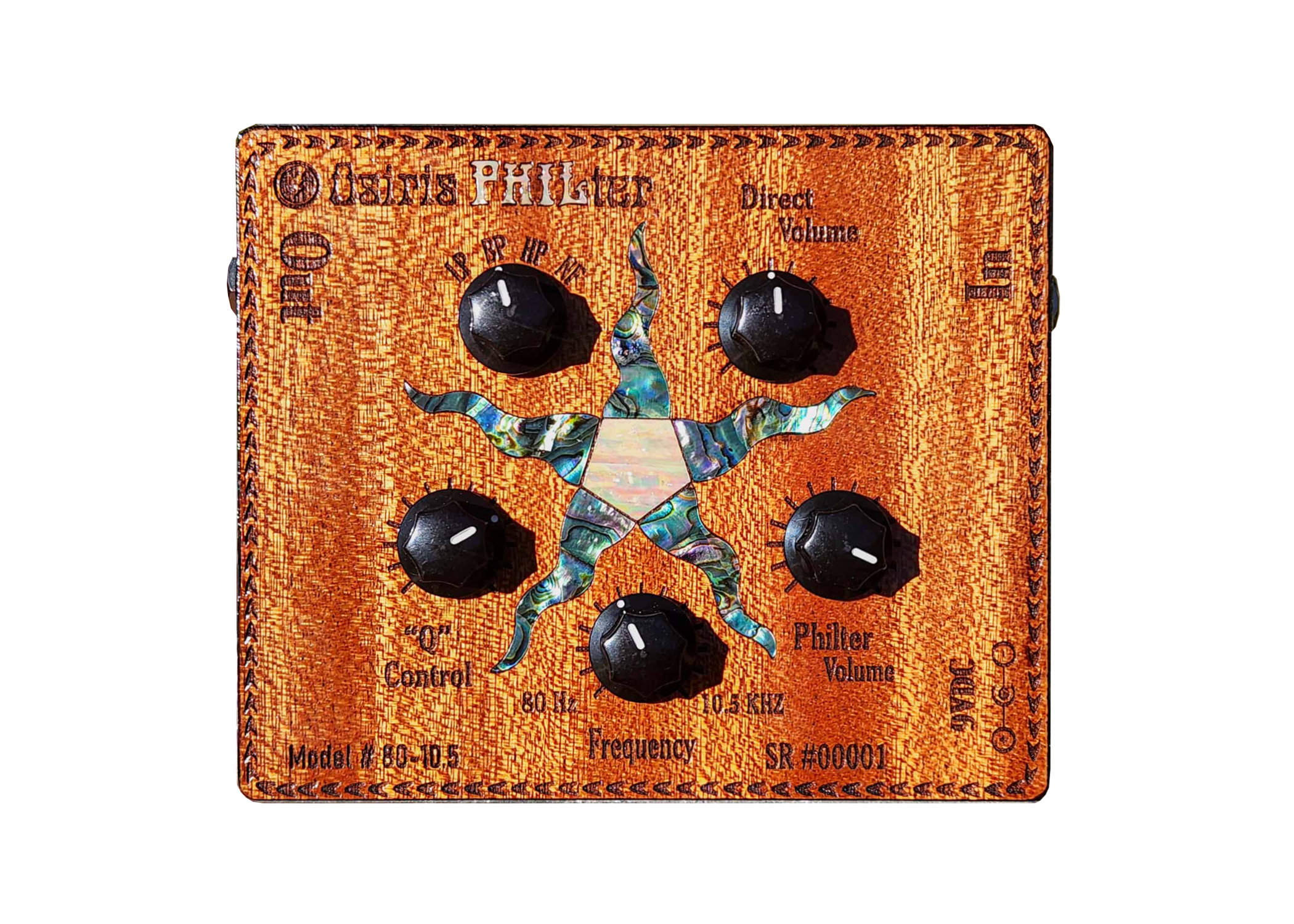 Image 1 of 2
 Image 2 of 2


